Showing posts with label ad campaigns. Show all posts

Monday, 27 February 2012

Just kidding...


Remember the advertisement of Dhara cooking oil where the little kid says, “Jalebi...!”? Even though the advertisement was broadcast on Indian television more than a decade ago, it is still etched in our memories. Probably, the only reason for this is the kid innocently saying “Jalebi...!

Circa 2012, and we are witnessing a similar trend in advertising in India. Many popular advertisements on Indian television have kids in them. These advertisements are spread over different sectors. From Flipkart.com, which has kids in all their advertisements to Hero Group’s latest advertisement where kids are crooning to the anthem, “Hum mein hai hero”; it is these kids who are the toast of advertising world.

This is an interesting and important development in a society, obsessed with advertisements featuring cricketers and Bollywood stars. All the sectors, at some stage or the other, have used the most popular names in cricket and Bollywood. From Amitabh Bachchan to Hrithik Roshan and from Sachin Tendulkar to Virat Kohli, actors and cricketers across generations have featured in multiple advertisements. And it has definitely fetched a lot of success to all the brands.

It thus becomes more interesting to understand, why kids have been used in advertisements for products, which are not meant for their age.

One reason is lowering stocks of cricketers due to repeated on-field failures. These failures have significantly diluted the popularity of all the cricketers, including Sachin Tendulkar and Dhoni, who were the toast of the nation after winning the Cricket World Cup in April 2011. Post that success, the Indian cricket team has failed in most of the tours and this has hit the market value of the game and cricketers. At the same time, some of the film stars have also been involved in “slap gates”, which has earned them negative publicity, which has had an impact on their advertising potential.

Also, there has been significant negativity and pessimism across the country because of new scandals and scams coming into the open. The society is feeling cheated because of these news coming up every second day. The moral values of our culture seem to have gone for a toss. It seems that we no longer trust adults with morals and ethics.

What better way, than to portray the innocence of kids, to win over this gloomy scenario. Indeed, kids symbolize innocence. Also, they bring freshness of thought and enthusiasm with their presence. Add to this, the easy association a kid can establish with not only kids, but all the generations. Another important aspect is the fact that in these advertisements, even if the kids are acting or being their usual self, they are very adorable and make the act very believable (and convincing). This adds a phenomenal value to the brand, of assurance and trust.

Prasoon Joshi, who has written the new jingle for Coca Cola, would surely agree to all of this. That is probably the reason he crafts all those kids to tell us, “Ummidon waali dhoop, sunshine waali asha…

“The future of this country”, is shaping today’s advertisements; ‘Already’!!

Thursday, 22 December 2011

AMUL Ads- The Taste of Advertising


World’s Largest Distribution Network, Most Trusted Brand in Food & Beverages Sector, India’s Top Brand; yes, you guessed it right, it’s AMUL.

It all began in December 1946, in Gujarat, at a then small place known as Anand. Started as a dairy co-operative movement, a brain child of Dr Verghese Kurien; Amul has now grown into one of the biggest food brands in the world. Amul products are today available in more than 40 countries including USA, Japan, China and the Gulf.    


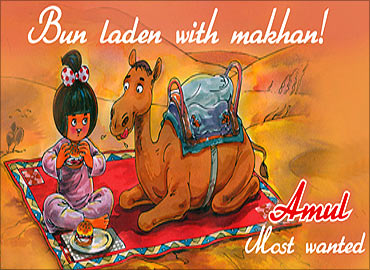
It is not only the milk production by Amul that is astonishing, but equally significant is the build-up of Amul as a Brand, that has been achieved over the years; through simple and imaginative advertising. Created in 1966 by Sylvester daCunha, the “Amul baby”, a girl in polka dotted dress; has been Amul’s mascot throughout. Initially the mascot was used only for Amul butter, with the tagline “Utterly butterly delicious Amul”. Over the years, the mascot has been used on all Amul products; though the advertising campaign is primarily for Amul butter.

                 
 The advertisements by Amul have always been well-liked by the people. The political and social comments, made through their advertisements, have been acclaimed by the masses. Highlights of Amul’s advertising campaigns can be considered to be:-

1)                  Hoardings Only: Amul advertisements are seen only on billboards and outdoor hoardings. These hoardings are selected in the prime locations of every city to catch the attention of maximum passers by. Every week a new ad is put up on the hoarding, and many people actually look forward to these ads. Amul has seldom used other media for its advertisements. Recently, newspapers have been used in some cities for Amul ads.

2)                  Simplicity:  Amul ads are very simple to understand. Mostly, the idea is expressed in only one sentence or phrase. The implied meaning of the tagline is easily grasped by the reader.

3)                  Humor:     The manner of the message in all the Amul ads has a light, happy mood attached to it. Even the most serious of issues are addressed in a very humorous way, which find easy connectivity (acceptability) with the audience. In fact, Amul ads can be surely regarded as great works of satire across all walks of life.

4)                  Continuity: The structure and format of the ad is the same always. The “Amul baby”, always in the ad, represents the masses and their sentiments. This continuity gives the campaign a cohesive look.

5)                  Adaptability: The ads modify/adapt the original tag line “Utterly butterly delicious Amul”, to suit the context of the ad. The theme of the modified tag line is such that it still goes well with various characteristics of butter.

AMUL ads, surely know, the “taste of India.


Saturday, 10 December 2011

'Ad'-ing value to brands


Advertisements on television have always been fascinating. They make audiences sit up and notice the product. We still remember certain ads which were aired many years ago. Like the Cadbury Dairy Milk ad, where the girl comes dancing on to the cricket field; and the Fevikwik ad in which a guy puts a stick in water and catches 4-5 fishes in one attempt.

In the past few years, we are witnessing a trend where a comprehensive ad campaign is being launched on television to market a product. Multiple ads, which promote the campaign line, are aired on television. These ads show multiple instances to prove the campaign line true and ensure that it remains in the minds of audiences, for a longer duration of time. The most popular of these campaigns has been the Vodafone’s ZooZoo campaign. Launched for the first time in April 2009, the campaign has been voted as the best ad campaign in many surveys.

The above discussed trend in television advertising seems to have gained significant popularity, in the past year or so. Many brands in different sectors like telecom, beverages, automobiles etc. have implemented ad campaigns on these lines. While most of these campaigns have been popular, some have not struck the right note with the audiences. Let us have a look at some of the campaigns, which have been highly appreciated by the audiences.

(a)               Brand: Maruti Suzuki. Tag line- “kitna deti hai?” The campaign successfully targeted the Indian mentality of “a country obsessed with mileage”. Instances of people asking mileage for space rockets, cruise liners and even military tanks were shown.

(b)               Brand: Tata Docomo. Tag line- “Keep it Simple, silly.The campaign has Ranbir Kapoor as the brand ambassador, posing as a stand up comedian. The different services offered by the mobile service provider were shown through stand up performances given by Ranbir Kapoor.

(c)               Brand: Pepsi. Tag Line- “Change the Game.The campaign was launched just before the 2011 Cricket World Cup and was on air for the complete duration of the tournament. The innovations in cricket like Helicopter Shot by MS Dhoni, Palti Hit by Kevin Pietersen etc were linked to Pepsi’s tag line of Change the Game.

(d)               Brand: Ceat. Tag Line- “When the streets are filled with idiots…The campaign advertised for bike tyres with better grip by Ceat. It showed different instances on Indian roads, when the rider has to put sudden breaks, to avoid accidents; which, is a regular occurrence. Instances like manhole left open on the road, kid walking out on the road while mother is busy with shopping etc are shown.

(e)               Brand: Airtel. Tag Line- “Har ek friend jaroori hota hai… The campaign advertised for its special plans and rates by relating it to different situations in which youngsters are caught up, and how a different friend helps in each of those problems; like the Kanjoos friend (friend gives missed call to cops) and Lifesaver friend (waiter at a restaurant acts as a lifesaver by reducing bill)

Many more campaigns have come up, similar to the above mentioned campaigns. The Idea Cellular 3G campaign, the Idea Cellular “Get Idea” campaign for mobile number portability, Vodafone’s “Happy to Help” campaign are a few examples. All of them have had an impact on the audiences and connected with them.